
Chippewa County Civil Docket Searches
Most searches begin online. MiCOURT Case Search is the statewide tool. It is the natural first stop for a Chippewa County civil court docket. You must acknowledge a notice before searching. The site explains that results are informational and not the official court record. Enter a name or case number, pick the civil category where offered, and note the court listed on the result. Some hits point to the local 91st District Court. Others lead to a Circuit Court file that needs clerk confirmation.
Older files take more work. When a Chippewa County civil docket is missing or thin online, use the local channels. The 91st District Court offers a public assess computer. Circuit docket displays sit at courthouse kiosks in the basement and outside the second-floor courtroom. For District record research, call 906-635-7613. Other numbers help too. The District Court main line is 906-635-6320, Circuit Court is 906-635-6338, and the County Clerk is 906-635-6300. Circuit copies go through the Clerk once the file number and exact payment are confirmed.
- Enter the known party name or case number in MiCOURT and choose the civil category when it is shown.
- Match the court and filing information before treating a result as the intended Chippewa County civil docket.
- Read the public case history for service, answer, motion, ADR, hearing, disposition, or judgment events.
- Use the District public assess computer or Circuit courthouse kiosk when an online result needs local confirmation.
- Ask the correct clerk for a copy after identifying the file number and the precise document needed.
Note: MiCOURT is a public lead only. The Chippewa County court that maintains the file controls the authoritative record.
Chippewa County Civil Docket Limits
Money decides the door you enter. Claim amount routes a Chippewa County civil docket to one court or the other. The 91st District Court's general-civil page sets out the test for general civil claims. District Court takes the case under a three-part test. The defendant must live in the district, or the action arose there. The plaintiff must have a direct interest. The claim must be $25,000 or less. A filing packet can include a summons, a complaint, or proof of claim. No attorney is required.
Bigger claims go upstairs. A Chippewa County civil lawsuit above $25,000 belongs in the 50th Circuit Court. The County Clerk maintains those Circuit civil files. Most are open to the public, the county says. Open still does not mean every filing is unrestricted or unredacted. That split is why the court field on a Chippewa County civil docket matters. Check it before you request a copy.
| Chippewa County civil route | Claim limit or focus | Record path |
|---|---|---|
| 91st District general civil | $25,000 or less, subject to the local venue and direct-interest rules | MiCOURT, District public assess computer, or District clerk |
| Small claims | Up to $7,000, with no attorneys appearing for a party | 91st District small-claims process and clerk |
| 50th Circuit civil | More than $25,000 | MiCOURT lead, Circuit inquiry, and County Clerk request |
The county's own general-civil page spells out the local claim limits and process rules for District civil cases.
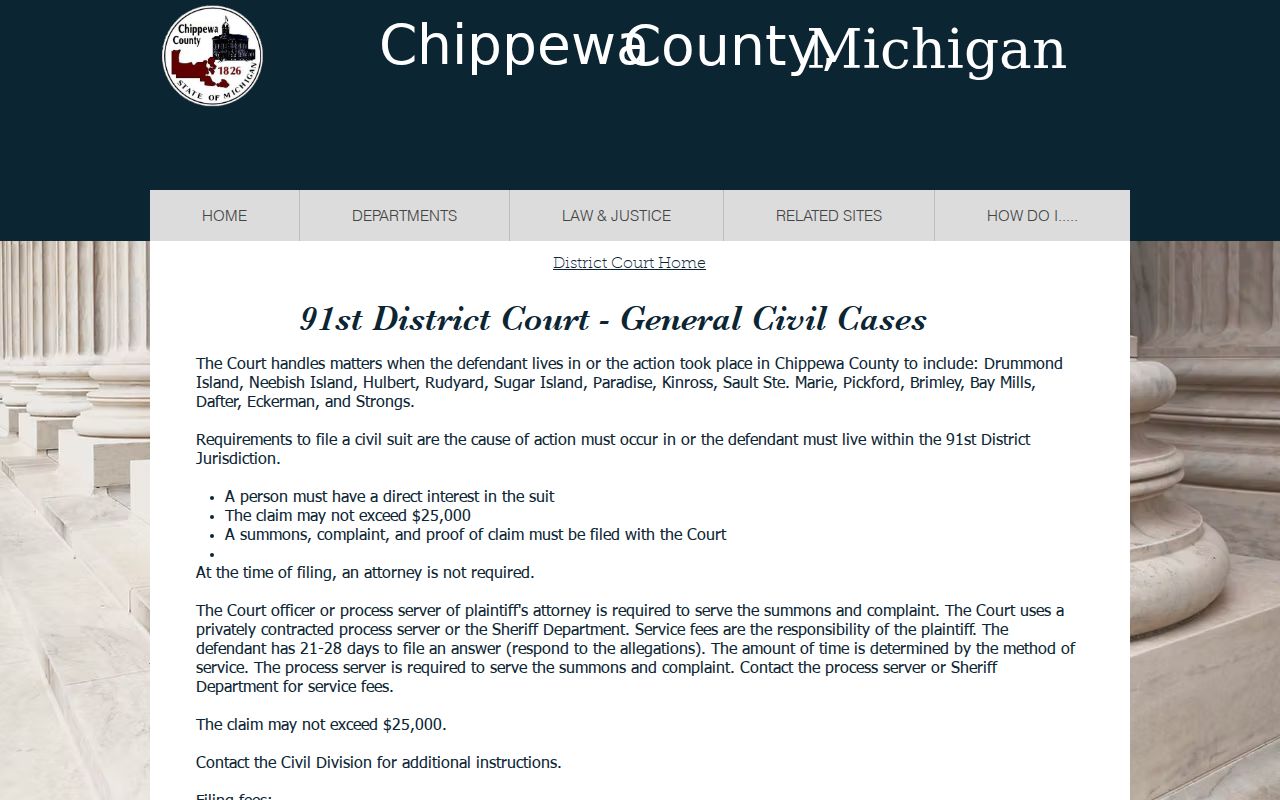
Those rules tie the dollar threshold to the court named on a Chippewa County civil docket.
Civil Dockets: What They Show
A Chippewa County civil docket is a case history. It is not a private-name sample. It is also not a copy of every document. The safe inspection inventory lists what a public result may identify: the court, the civil case type, the filing date, and the public event history. Parties or attorneys can appear as displayed. A claim category or amount shows where publicly displayed, and later entries may cover service, an answer, motion work, ADR, trial, disposition, or judgment.
| Case number and court | The identifier and court that connect a public Chippewa County civil docket to the correct clerk. |
|---|---|
| Case type and filing | The civil category and filing date, plus a claim category or amount when that information is publicly displayed. |
| Parties and attorneys | Party and attorney fields as the public record presents them, subject to access limits. |
| Service and response | Summons or service status, an answer, and motion events that move the civil case forward. |
| Resolution | ADR or mediation, a trial setting, disposition, judgment, and public document-copy availability. |
Michigan calls this record a case history. MCR 8.119 uses that term for the docket-like record. A calendar is something else entirely: the schedule of cases, times, and places, not the full Chippewa County civil case history.
Chippewa County Civil Docket Service
Service and an answer matter most after filing. Those entries show a Chippewa County civil docket has moved past the opening paperwork. In a District general-civil case, service may come from a contracted process server or the Sheriff. The plaintiff pays the service costs either way. The answer period generally runs 21 to 28 days, depending on how service was made. From there the docket may show motion work, ADR, trial, default, collection, or judgment activity.
Small claims follow their own path. The county allows certified mail, the Sheriff with mileage, or an adult process server who is not a party. Proof of service must be notarized. It must also be filed seven days before the hearing. Each step becomes a factual milestone on the docket. Court staff and judges cannot give strategy advice. Read a Chippewa County civil docket for its record entries, not for answers about what a party should argue.
Note: A service entry and a hearing date are two separate events on a Chippewa County civil docket. Confirm both when attendance is required.
What Cases Fill the Civil Docket
Work backwards from the route a Chippewa County civil docket took. Do not start from a guess at a label. General civil claims inside the District Court limit follow venue and direct-interest rules. Anything above the ceiling belongs to Circuit Court, and the County Clerk keeps the files there. Small claims run on a separate, simpler track. Every route builds a case history of filings and court events. Those may be open to the public unless restricted.
Small claims cap out at $7,000. No attorney may appear for a party there. Parties must hand in written statements, witness statements, photos, and exhibits at least two days before the hearing. A small-claims docket entry shows the hearing and any resulting action. It will not display every exhibit.
The Chippewa County small-claims page sets out the local ceiling and how to file.
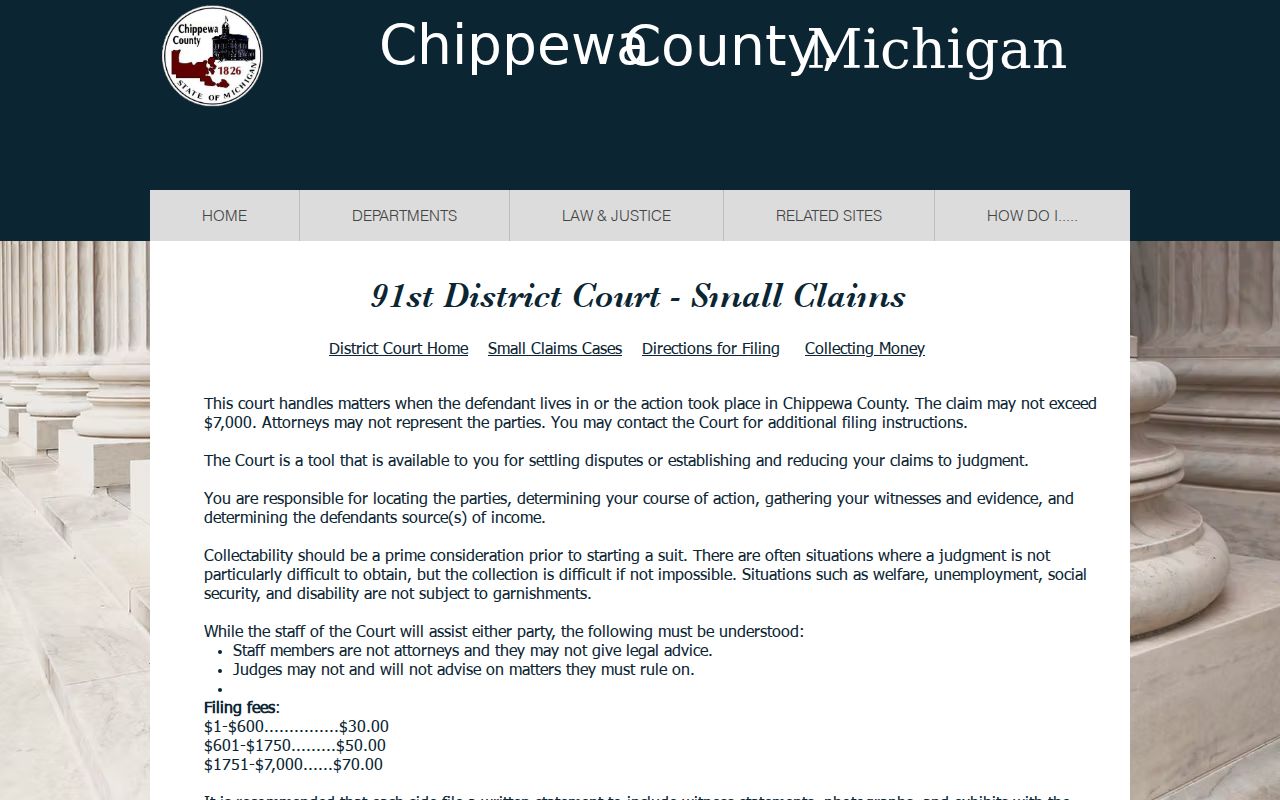
A Chippewa County civil docket ties into the small-claims process, including its evidence deadlines.
Chippewa County Civil Docket Fees
Fees give useful context when you read a Chippewa County civil docket. The numbers can change. Confirm with the clerk before filing. In District general civil, the fee depends on the amount claimed. The local page also prices a non-money action and a jury demand. Small claims use a lower three-tier schedule of their own. Service costs sit outside the filing fee.
| Chippewa County filing type | Amount range | Local fee |
|---|---|---|
| General civil | Up to $600 | $35 |
| General civil | $601 to $1,750 | $55 |
| General civil | $1,751 to $10,000 | $75 |
| General civil | $10,001 to $25,000 | $160 |
| Other than money / jury demand | Local general-civil entries | $75 / $50 |
| Small claims | $1 to $600 / $601 to $1,750 / $1,751 to $7,000 | $30 / $50 / $70 |
A fee is not a result. It belongs to filing, while the docket records what the court did later in the case.
Hearings on the Civil Docket
A Chippewa County civil docket traces a path. It starts with service and answer. From there it can run through ADR or mediation, a judge or jury trial, default, collection, and judgment. The general-civil page names ADR or mediation as a stage that can come before a trial setting. A court calendar helps you find an event. It is not the whole record. Verify any hearing that matters with the notice or the clerk. A public calendar can change. It can also leave out a restricted event.
In small claims, you cannot get a continuance by phone. The local procedure wants a written request seven days before the hearing. For an attendance check, the District Court's calendar page and its clerk are the practical local options. Before calling, jot down the court, case number, date, and event type. One calendar can span several courts and judicial officers.
- ADR
- Alternative dispute resolution, including mediation or another local settlement process.
- Setting
- A scheduled court proceeding or event, distinct from the full case history.
- Default
- An action or judgment that can follow a party's failure to appear or respond under the applicable procedure.
- Disposition
- The closing court action, which can include a dismissal, judgment, or another recorded result.
Chippewa County Civil Docket Defaults
Missing a small-claims appearance carries specific consequences. A plaintiff who fails to appear has the claim dismissed within 21 days. A defendant who fails to show faces an automatic default judgment. Either way, reopening takes a $20 motion. That makes the attendance and disposition entries matter. Read them in full context on a Chippewa County civil docket.
A decision heard by a judge is final. A magistrate-heard matter, though, may be appealed under the applicable rule. For local default and reopening details, the county's procedure page is the source. The court or clerk can confirm the status of a specific case. A public entry alone cannot tell you whether a person got notice. Nor whether later court action changed the result.
The Chippewa County small-claims procedure page holds the service, continuance, and reopening material.
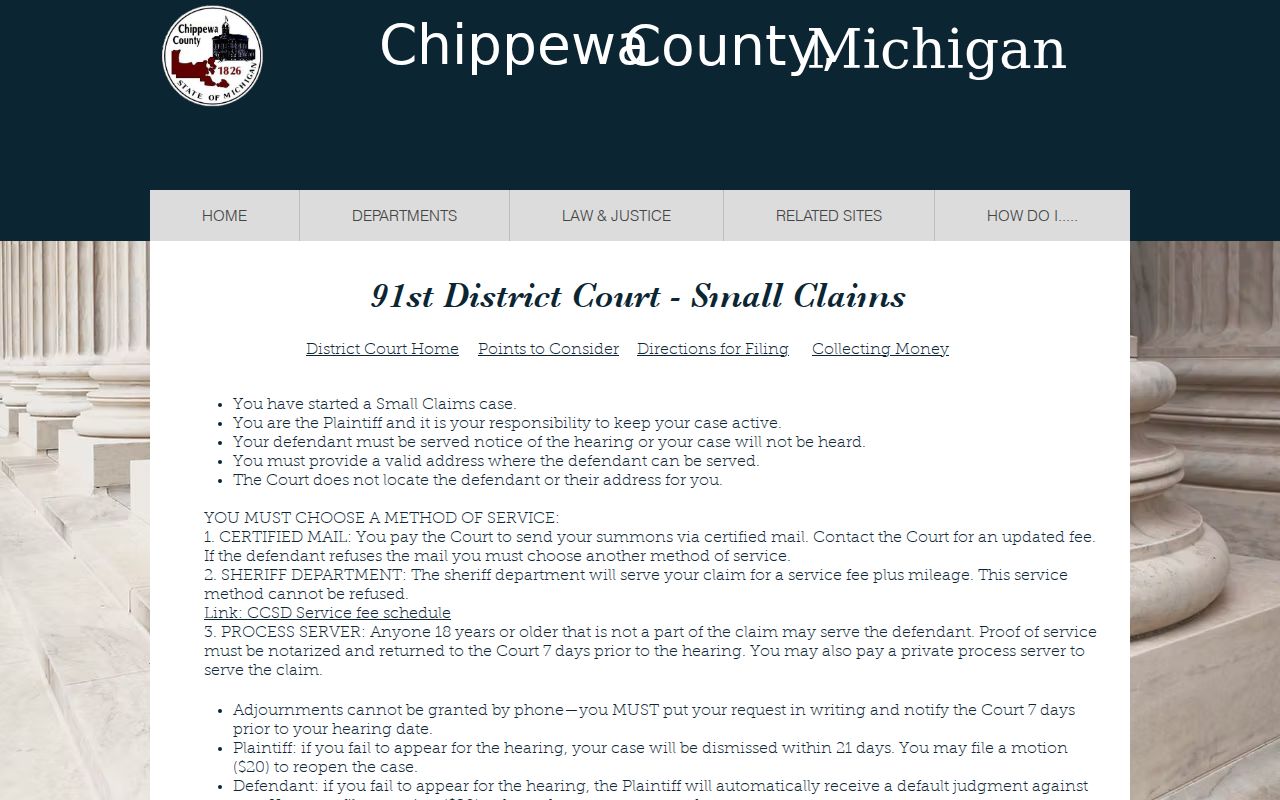
The procedure page ties a Chippewa County civil docket outcome to local service and reopening deadlines.
Who Can See Civil Dockets
Case records stay open unless a law, court rule, or order restricts them. Under MCR 8.119, anyone may inspect a public case history or document through the permitted court channel. No inspection fee applies. Copies can cost money. The file cannot leave the courthouse. Reading a Chippewa County civil docket is not the same as getting a paper or certified copy.
For Circuit civil documents, the County Clerk's request route wants the case number, document type, names on file, and the date. It also asks for a regular or certified-copy choice. The Clerk asks requesters to confirm the exact amount before paying. A regular copy runs $1 per page. A certified copy is $10 for the first page and $1 for each additional page. The form lists fax 906-635-6851 and vitalrecords@chippewacountymi.gov. Confirm the current delivery method with the Clerk.
Public-record boundary:
MCR 8.119 governs public case history, calendars, inspection, and reproduction.
MCR 1.109 addresses filing practices and protected personal information.
AO 2006-2 describes public and nonpublic access standards for Michigan court records.
Note: a public Chippewa County civil docket can omit sealed, protected, or otherwise nonpublic filings even when the case itself is visible.
Chippewa County Civil Docket Copies
Copies of Chippewa County Circuit civil files start with the County Clerk. That office keeps the files. The county treats most of them as public. Try the MiCOURT public search first. If that falls short, ask about the file. Ask at the courthouse or with the clerk directly. Sometimes you need an actual copy of a pleading or other court document. Then use the court-document request form. District civil and small-claims cases work differently. Those run through the District's public access computer or a clerk research channel. The District has no published copy fee table. Ask the clerk to state the cost before you file a request.
One more thing about a Chippewa County civil docket. FOIA covers county administrative records, not court files, so it cannot replace the court-file rules. Access to sealed, protected, and nonpublic court material is governed by Michigan AO 2006-2. MCR 8.119 and the state records standards also apply. The authoritative file stays with the court of record and its clerk.