
Chippewa County Court Record Requests
Bring the basics with you. That means the court, the case number, and the type of paper. Add a date if you have one. For civil and criminal files from the 50th Circuit Court, the County Clerk's court-document process is the place to start. MiCOURT can point you toward a case. The court of record controls the actual file. A public case history also helps you tell a hearing date apart from the papers in the docket file.
You have several ways to pursue Chippewa County court records. The online Circuit request form and the public case-search material offer a lead. Permitted files can be inspected at the clerk counter. Call ahead for a quote. Or use fax, email, or mail once you confirm the current method. The County Clerk sits at 906-635-6300. Circuit Court is 906-635-6338, District Court research 906-635-7613, Probate 906-635-6314, and Juvenile or Family Division 906-635-6316.
- Match the request to 50th Circuit, 91st District, Probate, or Juvenile or Family Division.
- Gather the Chippewa County case number, names on file, document type, and date.
- Ask the responsible clerk whether the Chippewa County court record is public and whether a regular or certified copy is available.
- Confirm the delivery method and total due before sending a request or payment.
- Keep the request narrow, then verify the received copy against the court file when accuracy matters.
Chippewa County Clerk Requests
The Circuit form doubles as a checklist for Chippewa County requesters. It wants to know if the file is civil or criminal. It also asks whether the copy is regular or certified, plus the file number and the names on it. Your relationship to a named person, the record type and date, and your contact details and signature round out the form. With those fields filled in, the clerk can pull one specific Chippewa County court record. A broad inquiry no longer gets treated as a request.
Call the office first with the case number and the exact amount due. The county says payment cannot be made without that information. The form header lists fax 906-635-6851 and vitalrecords@chippewacountymi.gov. Confirm the current method with the Clerk before sending a Chippewa County request. That extra step pays off when a docket holds several filings with similar dates.
Note: The County Clerk serves only the Circuit Court. District, Probate, and Juvenile offices keep their own Chippewa County record functions.
Court Record Types
Chippewa County court records are not one interchangeable pool. Circuit civil and criminal files sit with the County Clerk. The 91st District Court holds district civil, criminal, traffic, civil-infraction, and small-claims records. Probate keeps estate and related files. Juvenile or Family Division material follows its own access rules. Statewide search results are a starting point. They never stand in for the right Chippewa County office.
- 50th Circuit civil and criminal Chippewa County case files.
- 91st District criminal, civil, traffic, civil-infraction, and small-claims records.
- Probate estate, guardianship, conservatorship, will, and related court files.
- Family and juvenile matters, subject to strict confidentiality controls.
- Case histories and calendars, which serve different functions in Chippewa County court work.
For a public lead, try the official MiCOURT Case Search, then take the Chippewa County case number to the clerk who holds the record. A missing result can mean an access limit. It does not always mean the case is absent.
Chippewa County Record Custodians
The 91st District Court's record-search instructions point to a public access computer in the courthouse. It is available during normal business hours. That Chippewa County access point is free for public research. Clerk research is described as nominal, though no numeric price is published. Ask which record you need. Ask whether certification is available, whether a research charge applies, and how payment must be made.
Probate records in Chippewa County reach back to 1828. That depth makes the Probate register a strong route for old estate research. Not every historic file is public, though. Wills, name changes, mental-health matters, guardianships, and protective records each carry their own limits. Juvenile and child-protective proceedings never appear in MiCOURT's public search. Send a request to the proper register with the exact case type. Do not rely on a general search box.
Court Records: What They Contain
Michigan's rules call the procedural history a case history; most people call it a docket. A Chippewa County case history may list the case number, court, type, filing date, event history, settings, and disposition. The fuller court record can go further. It may include filed pleadings, orders, judgments, or public document links. What you can inspect or copy depends on the case. It also depends on the access status of each item in the file.
| Case history | Chronological Chippewa County events and actions, sometimes called a docket. |
|---|---|
| Case number | The court-assigned identifier used to connect a public result to a clerk request. |
| Calendar setting | The scheduled date, time, and place of a proceeding, not the complete court file. |
| Filed papers | Public pleadings, motions, orders, judgments, and other documents when access permits. |
| Public status | The visibility limit that can keep a Chippewa County item from public display or inspection. |
Michigan's MCR 8.119 treats the case history and the calendar as two different things. That distinction matters when a Chippewa County search needs a hearing time, a document copy, or both.
Chippewa County Record Search Limits
Public access to Chippewa County records has firm edges. A search may omit juvenile, child-protective, sealed, or otherwise nonpublic matters. Probate and family records can hold protected details. That can be true even when part of the case history is public. And a blank result proves nothing. A Chippewa County case can exist without appearing in a public docket search.
Michigan standards require public case histories and calendars to leave out nonpublic material and protected personal identifiers. When someone lacks lawful access to a nonpublic record, the permitted public answer is that no public record exists. That is an access response, not a finding on the underlying matter. When asking a Chippewa County clerk to locate a file, leave out personal identifiers. Skip any you do not need to include.
Copy Fees and Certification
The 50th Circuit sets two prices for Chippewa County copy work. A regular copy is just a plain reproduction of the page. A certified copy comes with the clerk's seal. Some recipients require that seal before they will treat it as an official court copy. A convenience fee may apply on top. The county tells you the exact amount before you pay. Call first with the case number, then confirm the total due.
| Chippewa County item | Published amount or rule |
|---|---|
| 50th Circuit regular copy | $1 per page |
| 50th Circuit certified copy, first page | $10 |
| Certified-copy additional page | $1 per page |
| District clerk research | Nominal fee stated, with no numeric amount published |
| Public inspection | No fee to inspect a permitted public case history or document |
District fees are separate. Ask the District clerk directly instead of guessing from Circuit pricing. Before ordering any copy, a Chippewa County docket search can help you pin down the right case.
Chippewa County FOIA Boundaries
A county FOIA request reaches administrative records, not sealed court files. Chippewa County accepts a written request by letter, fax, or email. No special form is required. Its published summary allows five business days for a response. An extension of up to ten business days is possible. When an estimate tops $50, the county can ask for a 50 percent deposit.
Send FOIA requests about county policies to the County Administrator's Office. For case records, the route is different. A Chippewa County Circuit Court copy goes through the Circuit form. The District, Probate, or Juvenile office handles its own files. Naming a sealed file in a FOIA request does not open it. The Chippewa County FOIA materials lay out the administrative process and its separate fee rules.
The official county FOIA page states these response windows and deposit rules.
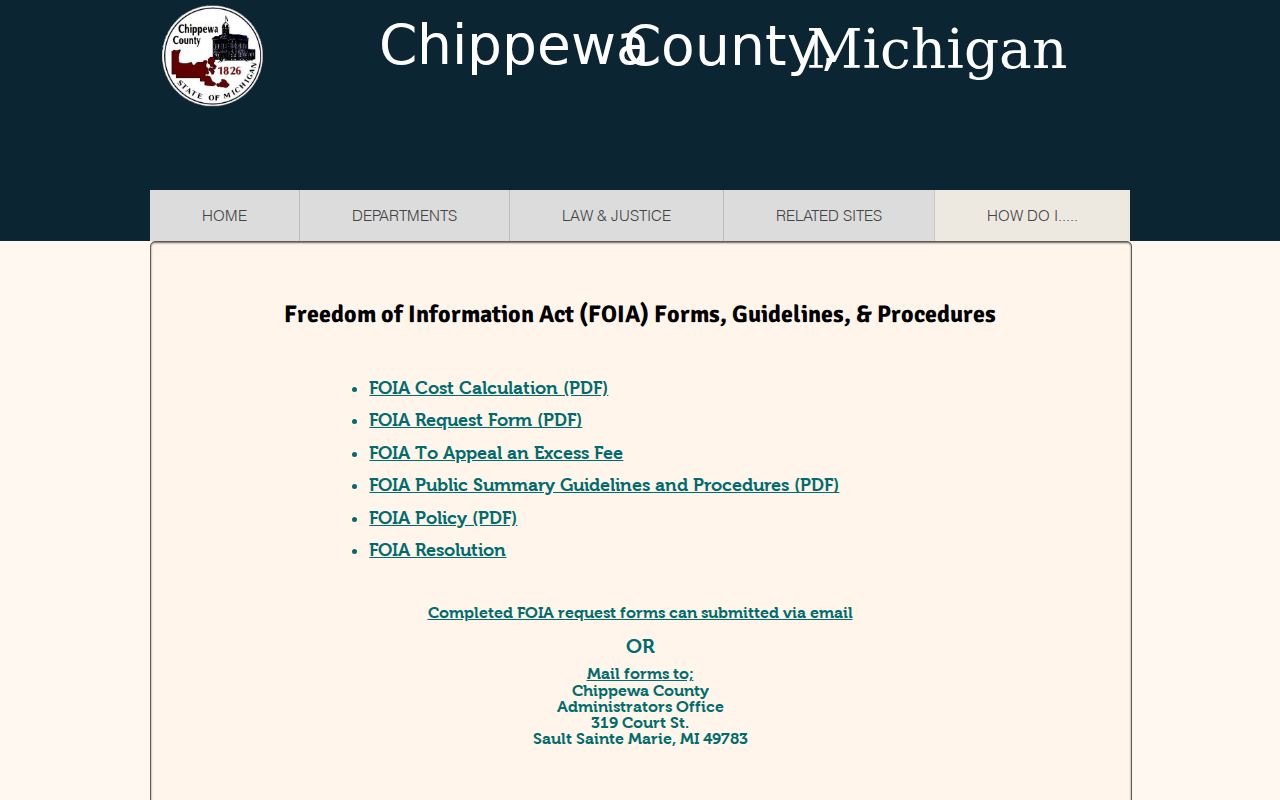
The distinction matters in practice. A county administrative request is not the same as asking the Chippewa County court clerk for a case file.
Access Rules for Court Records
MCR 8.119 puts each case file in the clerk's hands. Public case records stay open in Chippewa County. A law, rule, or court order can say otherwise. Inspection is free. You may view a permitted case history or pull a permitted document without paying anything. Reproduction is different; under MCL 600.1988 the court can charge actual cost. And no file leaves the courthouse.
Key Michigan access rules:
MCR 8.119 governs case histories, calendars, inspection, and reproduction of court records.
MCR 1.109 addresses filing and protected personal information.
AO 2006-2 sets public and nonpublic court-record access standards.
Note: A Chippewa County record can be partly public. A sealed attachment, restricted detail, or protected identifier can still be off limits within it.
Chippewa County Historic Records
Old records need the same custodian check as a current Chippewa County request. Probate holdings reach back to 1828. District Court is slower for older files. Records more than 25 years old are not computerized. Give the District clerk a name, a date of birth if you have one, and a specific period to check. Its standard search covers ten years.
Federal cases do not sit in the Chippewa County clerk's system. For those, the PACER National Case Locator is the separate federal route. It only helps when the case truly belongs in federal court. Confirm which court kept the file before you pay for any copy.
The PACER National Case Locator covers federal cases across the country. That reach is why it stands apart from a county record request.
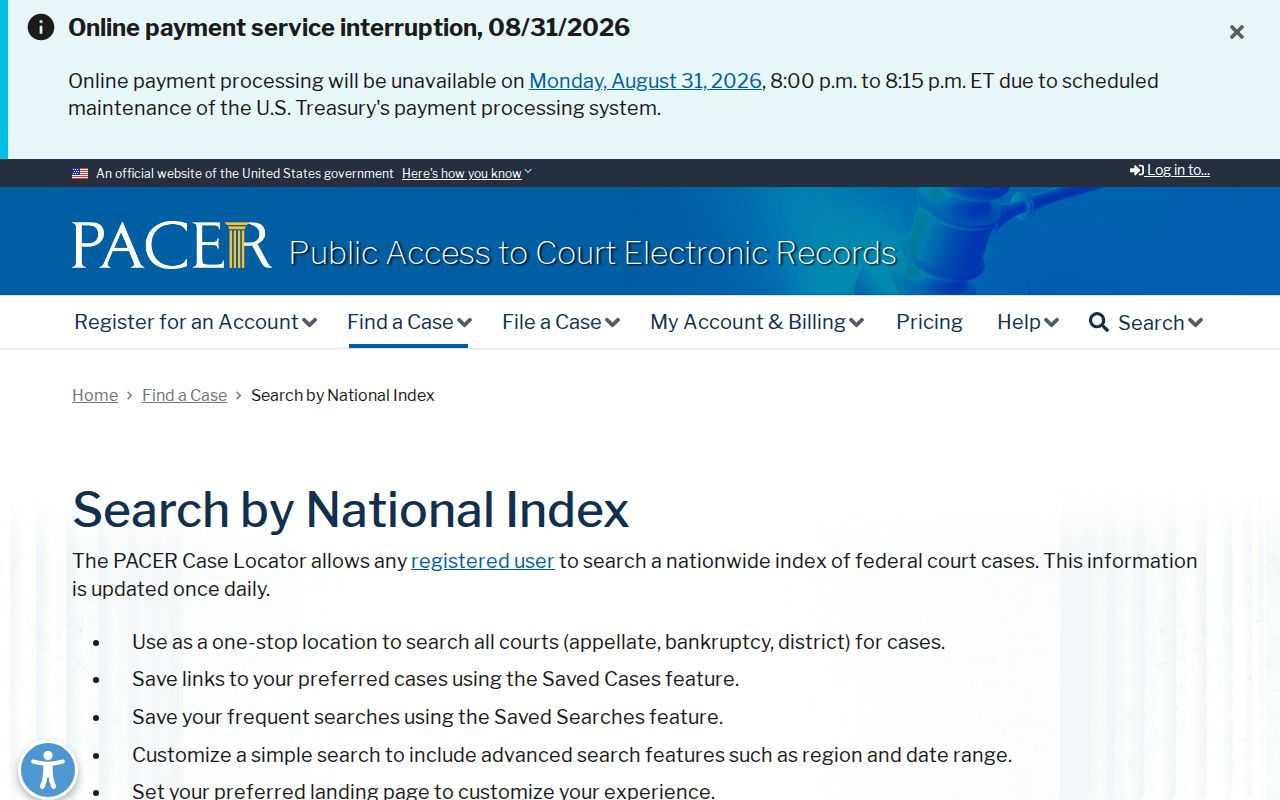
The federal search screen makes the split clear. A Chippewa County state-court file and a federal docket come from separate custodians.